We will ponder: “Might the financial crisis be followed by national crises?”
Alessandro Giraudo – Chief Economist, Tradition Viel (in the studio like myself)
Ondine Smulders – The Economist (calling in from Athens)
A (to be determined) Reuters Breakingviews’ journalist (calling in from London)
Podcasts :
First part.
Second part.
No Comments »
Conceptual artist Little Shiva who helped me design Santa Crisis last year informs me she went to Copenhaguen in her capacity of a polar bear.

No Comments »
Cityislander’s imaginative translation of “La nuit du 4 août” at the French end of this blog. Many thanks to him!
Exactly 220 years ago (the French Revolution), on the night of August 4th, 1789, the question certainly was not about systemic risk. Yet, on that very night, an event of systemic magnitude occurred: the French assembly ended the feudal system and its privileges.
Keeping this historic event in mind, we have to reflect on the fact that we have not yet fully grasped that when systemic risk became an issue in 2007, capitalism wasn’t just going through a rough patch. Rather, it had been mortally wounded. Our politically correct attempts to see green shoots in the economy and marvel at them epitomizes wishful thinking.
The old fashion way to save capitalism, the socialization of losses, proved insufficient, this time to absorb the sheer size of the systemic shock, only matched by the enormity of the debt binge that caused it over the past 35 years. Tax havens had allowed the wealthy to evade the IRS, leaving the middle class to pay for the bailouts. This time, however, the price tag is simply unaffordable.
Without a viable solution, we look the other way and comfort ourselves with the illusion that things will heal over time; a propaganda, that is generously fed by the establishment. Isolated havens of prosperity have emerged, the pitiful benefits of the purported trickle down economics behind the massive bailouts.
The less fortunate were left to face dire prospects on their own, while at the same time the available resources were given in priority to the few banks still standing, thereby confirming the oligarchy theory. Looking back, they seem to have been pulling the strings all along. Lehman Brothers, declared bankrupt on Sep 15 of last year, was a rival of “Government Sachs”. Wasn’t it meant to happen, then?
In the heydays of finance, competition was rife between banks, yet markets were deemed resilient. The high-jacking of capitalism by banks, however, eventually brought it to its knees. With the benefit of hindsight, we’d like to think that everything would get back to normal if only we got rid of the bad guys. Alas, our awakening comes after the fact. The goose that lay golden eggs is gone.
In spite of occasional rallies, under IV therapy by the government, Wall Street’s attempts to resurrect its glory are eventually deemed to failure and will only reflect the desperate attempts of its kings to stick to power.
When the new system takes over, we will not see it for what it is: the replacement of a broken system by a new one. Rather, we will clamor that reason won over a corrupt elite, that drowned in its own excesses.
5 Comments »
A reader of my French blog has taken the trouble of translating my most recent Friday video in English. Many thanks to him!
NEWS is conveyed by letter, word or mouth
and comes to us from North, East, West and South” (Witt’s Recreations)
. . . but mostly from the Paul Jorion blog now that we have the Internet.
I want to talk to you about the stock market, because the stock market has been rising in France and in the United States. I am obliged to reflect upon this, because, as I have mentioned to you, I have agreed to prepare an afterword to a new edition of several works of Proudhon concerning stock-market speculation. It is important to understand what is happening at the moment. Does it mean that the economy is improving? To that end we need to look back at the events of the past two years.
In the summer of 2007 we witnessed the drying up of inter-bank credit, by which is meant that the banks stopped lending to one another. I remind you that the reason for this is that there was a depreciation, which began to become quite spectacular from February of 2007, in the value of securities consisting of large collections of individual mortgage debts, because many people were no longer able to keep up their monthly repayments. Consequently, the value of these securities plunged. In the summer an air of general suspicion arose from the fact that banks did not want to reveal whether they possessed these products, which could no longer fetch a price, because there was now no market for them. Everyone in the world of finance suspected everyone else of possessing these products and thus of possibly being insolvent. An unwillingness to lend developed, as no one could be depended on now to be credit-worthy.
I shall remind you of the first measure that was thought of to deal with this problem: the creation of what were known as ‘bad-value banks’ or ‘bad banks’. The possibility was envisaged of putting toxic derivatives into a form of quarantine so that the banks could get them off their balance sheets. So ratios of solvency were worked out, to see whether they were above or below the threshold of solvency. What happened, as has recently become known, is that the British, who were in much the same position as the Americans, came to the conclusion that it was impossible, as it would be too expensive.
The second idea, which was adopted in previous crises, is known as ‘privatization of profits with socialization of losses’. This solution, which had always worked very well before, means that the private sector gets whatever profits there may be when things are going well and then, when things go badly, the state, i.e. the taxpayer, forks out to cover the losses. The novelty in the crisis in which we find ourselves now is that this classic solution can no longer be considered, as that too would have cost too much, the level of debt which had been incurred having exceeded the capacity of states to absorb it.
Read the rest of this entry »
5 Comments »
A blog gives you visibility, allowing people from all over with views akin to yours getting in touch. That’s what happened a couple of months ago with conceptual artist, Little Shiva asking: “What about a common project?” I told her of a possible allegory for the crisis, a symbol that you could copy here and there, whose name would be Santa Crisis.
After some going back and forth, here he is: a jolly old elf!
Make him known: that’s the idea. Just inform where he was born: here and there.

Click to enhance.
No Comments »
Here is the communication I made on March 3rd to the Socialist members of the European Parliament in Brussels as my contribution to the one-day conference entitled “Closing the casino: building a fairer and stronger real economy”
Modern societies of European origin were historically built according to a tripartite structure composed of warriors-raiders, priests and commoners. By the time the new concept of democracy emerged, the land and the wealth buried in it had already been distributed by the warriors-raiders between themselves. Inheritance of property had contributed at strengthening this pattern. Bourgeois revolutions of the eighteen century condoned the addition of the power of money to that of strength only. From then on cash buttressed the power balance that the sword had first put into place. In the twentieth century, colonialism and paradoxically communism, ensured the full globalization of that order of European origin. Current appeals for “leveling the playing field” ignore the lack of evidence that the field was ever level.
Stock options: the holy alliance between investors and company executives
In an infamous quote that Ben Stein had him concede for the New York Times, investor extraordinaire Warren Buffet stated: “There’s class warfare, all right, but it’s my class, the rich class, that’s making war, and we’re winning.” This statement marked the return in common parlance of an outmoded way of speaking. Indeed, with the rise of the Chicago School, the phrase “class warfare” got tabooed and the words “capitalists” (aka “investors”), “bosses” (aka “company executives”) and “workers” (“employees”, “associates”, “team members”, etc.) removed from the economic literature and replaced by the catch-all notion of “monetary mass” as part of a more general process where “physical forces” replaced “people” in explanations of the economy. That didn’t mean though that class warfare was over or had never taken place. The decisive and final move came in the late 1970s when McKinsey devised “stock options” by which the “interests of investors and company executives would henceforth be aligned.” The plan succeeded beyond both parties’ wildest dreams.
The distribution of wealth: what happened to it
Prior to stock options, wage-earners were part of a triangular power game where investors and executives kept each other at bay. With the introduction of stock options, those days were over: a holy alliance was born to which wage-earners were no match. Predictably, their piece of the pie dwindled down. Any attempt they would make to increase their share would be brutally countered by central banks concerned with monetary masses and raising interest rates – that is: raising unemployment – forcing wage-earners to pipe down.
With lower revenues, wage-earners were led to ever borrow more. Commercial banks graciously obliged. Meanwhile, companies had got in the habit of borrowing rather than reinvesting so that by now any money that anyone needed was borrowed. Interest payments were mushrooming, becoming a burdensome component of every price. “Capital” – being money you don’t have but still need – kept concentrating in fewer and deepening pockets. The more capital is concentrated the less likely it is though that it happens to be where it is actually needed.
Speculation: the ascent of the Speculative Society
What do you do then when you don’t have the money you need and you know that working harder won’t make much of a difference ? You buy a lottery ticket. By the end of the twentieth century everyone had come to that same conclusion and “bubbles” and growth had become synonymous notions.
You buy stock but not for dividends which are boringly your share in the surplus the company has made through the stock you purchased, no: you buy stock for capital gains. To insure that this happens the stock exchange needs to be turned into a casino. The price of Total or BP stock needs to change every five seconds. Not that there is anything in the business of Total or BP justifying that the price of its stock changes every five seconds or for that matter even every five days. But it is needed for the stock market to be run as a casino where huge capital gains may materialize. When the scheme stops working, it crashes, which happens indeed every eighty years or so.
Hunger riots stirred by museums and hospitals
If only people who have wheat to deliver or to take delivery of were trading wheat the price of that cereal would be determined by how much of it gets produced and how much is needed: what is commonly called supply and demand. But this is not how things work nowadays: the price of wheat gets determined by bets made by big institutional investors such as pension funds, university endowments, hospitals and museums. A reasonable social expectation is that they would focus on offering pensioners annuities, teaching pupils, curing patients or displaying art, but they are not: they are heavily busy pushing the price of wheat up or down with the goal of protecting their assets and no concern whether anybody would live or die as a consequence of their speculation.
Spot and futures markets allow those exposed to an actual risk (due to the weather, the economic environment, etc.) to cover their positions, hence reducing overall risk. Speculative “naked” positions on the contrary artificially create risk where there was none. Coverage provides an insurance while “naked” positions are risk-generating bets. Insurance protects the economy while bets kill it and measures should be taken accordingly. The means for banning betting on the fluctuation of prices are simple: they are spelled out in FASB 133, a rule issued by the American Financial Association Standards Board that establishes a fiscal differential treatment for coverage and naked positions. FASB 133 should be upgraded to a badly needed and clear-cut prohibition.
Recommendations
1. Break the unholy alliance between investors and company executives: the social fabric is being damaged as we speak. Ban stock options.
2. Free central bankers from monetarism: societies are not made of monetary masses but of people. Central banks have a more crucial role to play than systematically siding with investors and company executives against wage-earners.
3. Apply urgently appropriate fiscal policy so that the chances increase that capital happens to be where it is actually needed.
4. Close down the casino: stop continuous pricing on the spot and future markets.
5. Bar speculators from commodities’ markets: bar “non-commercials.” Let them focus on what they do best: teach pupils, cure patients and display art for the enjoyment and education of the public.
6. Encourage insurance but ban bets on the fluctuation of prices.
6 Comments »
Published in Le Monde – Economie, March 2nd 2009 (transl. Danielle Goodman)
Let’s assume that governments are actively concerned with the interests of the populace at this very moment – an ardent hope of mine. To succeed, their actions have to benefit from a certain surprise effect so as not to be thwarted in advance by those who know how to use the new measures for personal gain.
Authorities therefore explain themselves as little as possible as far as their planned initiatives go, and when they do so, to calm people’s worries, their explanations are formulated in such oracular terms that it is difficult even for experts to know what they are talking about. But in the absence of content, they work on the form: their communiqués exude confidence and repeat with affability that the files are in the right hands.
The task is not easy, since those who explain that everything will soon be back on track are the same ones who repeated at the beginning of the crisis, with a sincerity that it would be hard to doubt today, that it was only of limited scope and would definitely, definitely be over soon.
The capital of confidence held by the authorities is thus eroded day by day. The listening public is pulled between two possible interpretations of their too-long silences and their half-truths: is it incompetence, or evil? Both opinions are being reinforced today, in Europe and perhaps even in Asia.
Incompetence for not having seen it coming, then for having underestimated the crisis as it first manifested itself, and now for holding back from taking the radical measures that no one doubts need to be made. Or else malice: so much incompetence is beyond belief, some would say. Our leaders and those who brought them to power know quite well exactly where they want to end up – that is, increasing their grip on power.
Therefore, the authorities’ stand is untenable: those who give them the benefit of the doubt are obliged to read into the deepening of the crisis the growing signs of incompetence; while those who are programmatically suspicious see mushrooming evidence of deliberate dark designs.
The American economist Nouriel Roubini explained on February 21st in an interview with the Wall Street Journal that it would take six more months for the American authorities to finalize the nationalization of the banking sector. If the measure is indispensable, then why not apply it straight away, asked his interlocutor? Because it will take six months, replied Mr. Roubini, until nobody will dare pretend to be solvent anymore –alluding to recent remarks by Kenneth Lewis, the head of Bank of America, which were meant to be reassuring.
That is only one example, but, given the gravity of the current crisis, six more months of the waiting game amount to an eternity. If those who lead us think that drastic measures have to be applied anyway, be it sooner or later, it becomes more urgent every day that they stop procrastinating. The mitigating circumstances conceded by those who judge them to be simply incompetent will no longer protect them from the anger of those who believe them to be evil.
No Comments »
Did you know that on February 17, 2007, Sen. Carl Levin, D-Mich., Sen. Norm Coleman, R-Minn., and Sen. Barack Obama, D-Ill., introduced comprehensive legislation to stop offshore tax haven and tax shelter abuses, the Stop Tax Haven Abuse Act, targeting $100 billion in lost tax revenue each year from offshore tax dodges ?
One of the provisions of the Act states the following :
STOP TAX SHELTER PATENTS by prohibiting the U.S. Patent and Trademark Office from issuing patents for “inventions designed to minimize, avoid, defer, or otherwise affect liability for Federal, State, local, or foreign tax”
This preposterous attempt at stifling innovation was fortunately nipped in the bud.
1 Comment »
The SEC (Securities & Exchange Commission) along with the OCC (Office of the Comptroller of the Currency) have just released their report on the valuation of financial products (Fair Value).
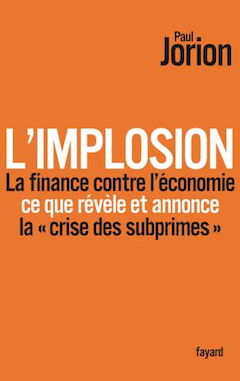
The subject is what I discussed in « Juste prix » et « juste valeur » and in L’implosion. La finance contre l’économie: ce que révèle et annonce la “crise des subprimes” (Fayard 2008: 188-202). The issue is the following: firms have requested that Marked-To-Market accounting is suspended for the time being as they regard current circumstances as exceptional and prices “unrealistically” depressed, too far removed in any case from their “true value”.
The report is bulky (255 pages) but its subject being pricing – my special expertise as a financial engineer – I will analyze it in depth and post a brief summary of my observations as a forthcoming blog. Should the full analysis be of interest to you as a financial establishment or a consultancy, please let me know (pauljorion@ucla.edu).
No Comments »
|